AAMVA Verification Guide
Audience: CRA processors and support teams. Purpose: Explain what AAMVA verification does, when to use it, how to dispatch it, and how to read the result
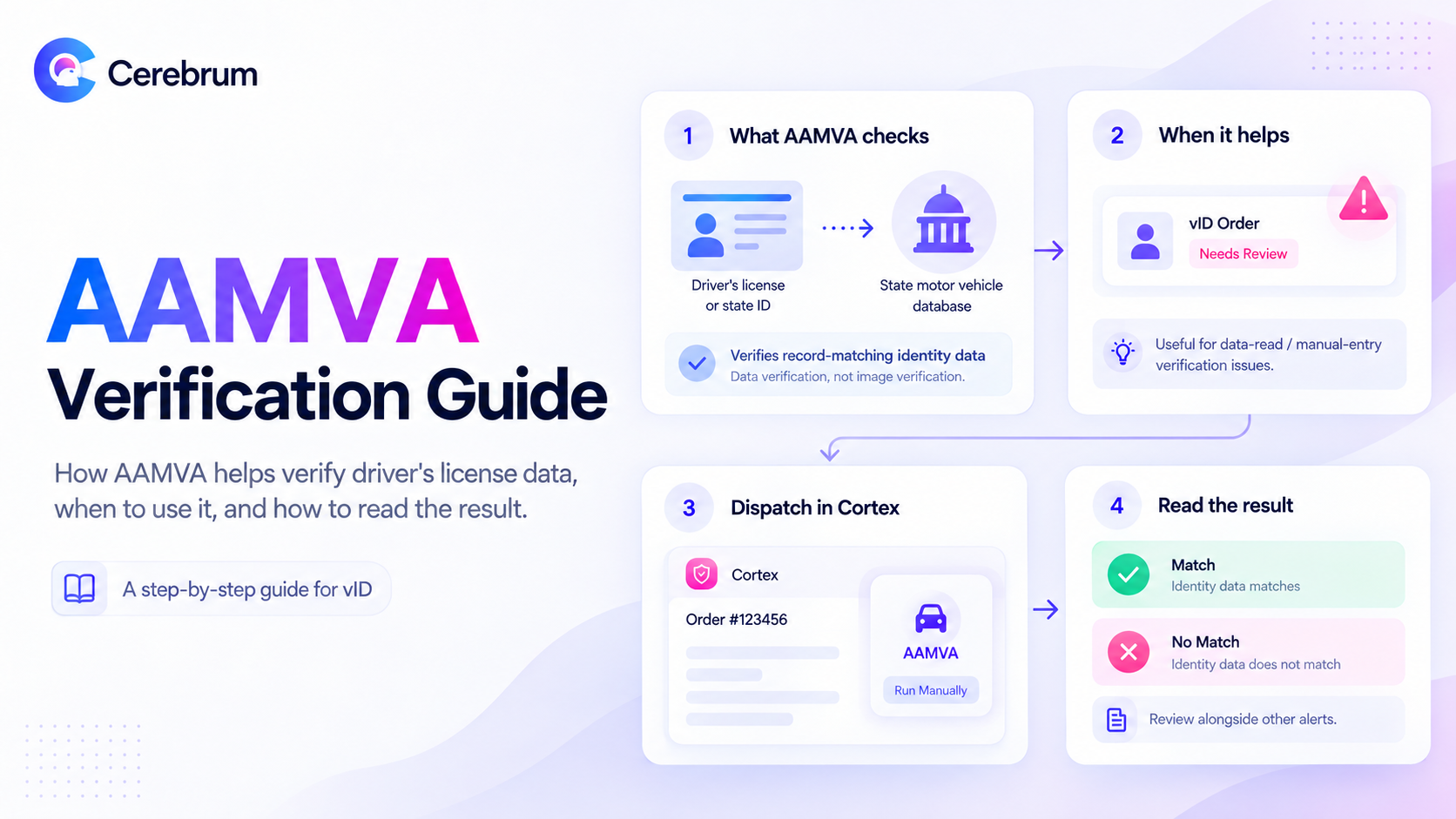
What AAMVA is
AAMVA verification checks the data extracted from a driver's license or state ID against the issuing state's motor vehicle records. It answers one question: does a record matching this document exist in the issuing state's database?
It is a data verification, not a document or image verification. It confirms that the identifiers are real and registered. It does not evaluate whether the physical document presented was genuine, unaltered, or held by the person who submitted it.
That distinction determines when AAMVA is useful.
When AAMVA helps
AAMVA can resolve a flagged order when three conditions hold:
The document is a driver's license or state ID from a participating jurisdiction.
The issuing state is supported. Coverage is not universal. AAMVA supports all states but NY, MN, UT, CA, and LA
The reason for manual review is one AAMVA can address — specifically, a failure to read or verify the document's data.
The clearest use case: an applicant's ID could not be read after two scan attempts and they entered their data manually. The order is flagged because the automated checks never ran against extracted document data. AAMVA can verify that the manually entered identifiers correspond to a real record, letting your reviewer resolve the order without asking the applicant to resubmit.
When AAMVA does not help
AAMVA cannot address:
Biometric failures. A selfie that does not match the ID portrait is not a data problem. AAMVA has nothing to say about it.
Photo forgery or photocopy alerts. These concern the physical document and image, not the underlying record.
IP address alerts. Unrelated to identity data.
Non-driver's-license documents. Passports, tribal identification, military IDs, and similar credentials are outside AAMVA's scope.
Running AAMVA on these orders will not clear the alert. Refer to the vID Alert-to-Action Matrix for the appropriate action.
Dispatching an AAMVA check
Manual AAMVA dispatch must be enabled on the package before it is available. If you do not see the option on an order, contact your Cerebrum representative to have it enabled for the relevant package.
To run the check:
Open the order in Cortex.
Locate the AAMVA car icon.
Confirm you want to dispatch the check.
Wait for the result to return, then refresh the order.
The result appears on the order and is included in the verification report where the package is configured to display it.
Reading the result
Match
The state's records contain a record consistent with the submitted data.
This is a meaningful positive signal on the identity data. It does not by itself resolve alerts relating to the image, the biometric comparison, or the connection. Review the remaining alerts before completing the order.
No match
The state's records do not contain a matching record. There are two common explanations, and they are very different:
The state has no record of this individual and license number. The data as submitted does not correspond to a registered record.
The state's database was unavailable at the time of the query. Individual state systems experience downtime, and a no-match returned during an outage is not evidence about the applicant.
A no-match is therefore not automatically a negative finding. Where all other verification checks passed, most CRAs treat a single no-match as inconclusive rather than disqualifying, and either re-dispatch later or resolve the order on the strength of the other checks. Where a no-match accompanies other alerts, it strengthens the case for escalation.
Your policy should specify how a no-match is weighted. Because that weighting can lead to an adverse determination regarding an applicant, we recommend establishing it with your legal counsel.
Common causes of a benign no-match
Recently issued or recently renewed licenses that have not yet propagated to the queryable record
Recent name or address changes
Transcription errors in manually entered data — worth checking the entered values against the ID image in Cortex before drawing conclusions
Temporary or interim credentials, which are generally not in the queryable record set
Displaying AAMVA on the report
Whether AAMVA is dispatched, the results will automatically get added to the vID PDF report.
Performance data
AAMVA is a recent addition to the vID product, and clearance-rate statistics are not yet available at a volume that would support reliable reporting. We will publish performance data once the sample is sufficient. If there are specific data points that would support your client conversations, let your Cerebrum representative know so they can be scoped into the reporting work.
In the interim, avoid representing a specific AAMVA clearance rate to clients or prospects.
AAMVA verification returns information from state motor vehicle records. How that information is used in an identity determination, and how it is described in any consumer report, is the responsibility of the CRA. We recommend reviewing your use of AAMVA results with your legal counsel, particularly regarding permissible purpose and any disclosure obligations attached to the underlying data.
Was this helpful?