Decision Ownership in the vID Workflow
Audience: CRA operations leadership, compliance teams, and processors. Purpose: Define who decides what and why the system is built that way
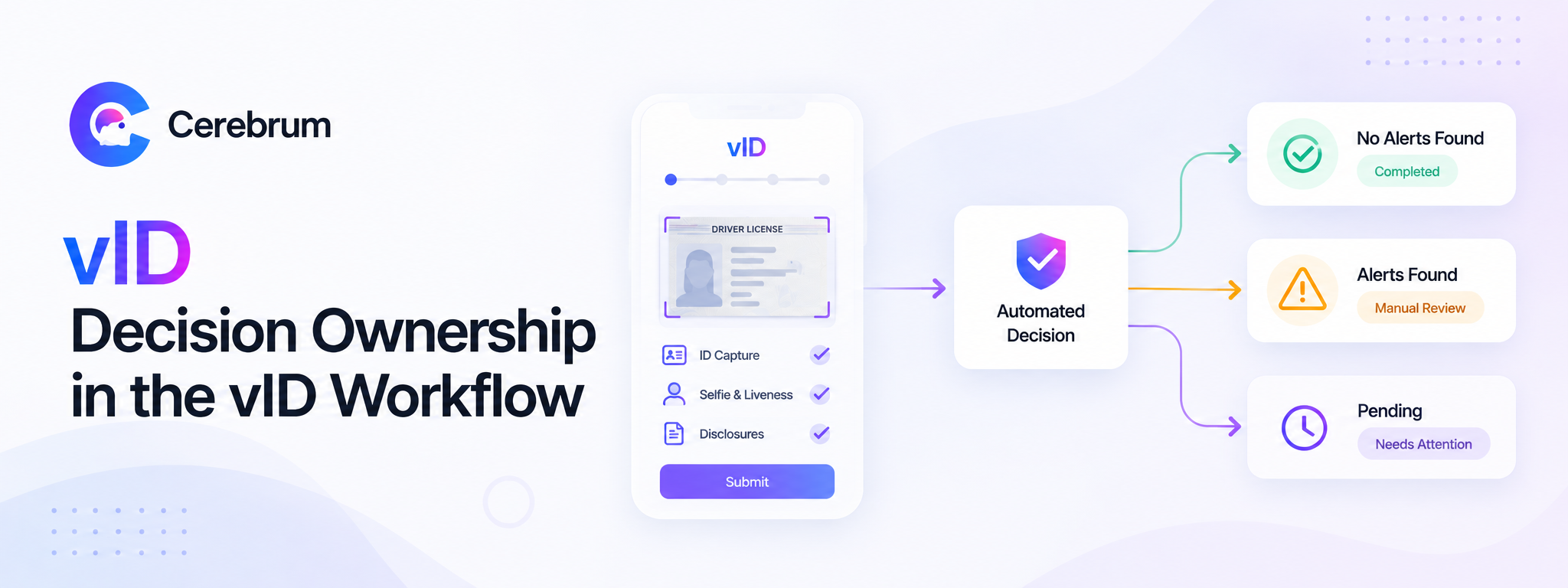
The short version
Cerebrum runs identity verification checks and reports what those checks observed. Cerebrum does not decide whether an applicant's identity is acceptable.
That decision belongs to you as the consumer reporting agency, or to your end-user client where your agreement assigns it to them. This is a deliberate architectural choice, not a gap in the product.
Why orders sit in Pending
When a vID submission clears every configured check, it auto-approves: the order moves to Complete with a score of ID Verified, with no human involvement.
When any check raises an alert, the order does not fail. It moves to manual review and holds a Pending status with a Pending score.
Pending is not an error state and not a backlog. It is the point at which the system stops and hands the decision to a human reviewer — because Cerebrum is not a consumer reporting agency and cannot deliver a final determination that an applicant's identity is or is not verified. Rendering that judgment is a CRA function.
An order remains in Pending until your team resolves it. Cerebrum will not auto-generate an outcome, close the order on your behalf, or convert a Pending order into a final score after a period of time.
Division of responsibility
Responsibility | Owner |
|---|---|
Running verification checks and returning results | Cerebrum |
Displaying what each check observed | Cerebrum |
Auto-approving submissions that clear all checks | Cerebrum |
Maintaining platform availability and data security | Cerebrum |
Explaining why an order was flagged | Cerebrum |
Establishing the review standard | CRA |
Deciding whether a flagged submission is acceptable | CRA |
Issuing reorders to applicants | CRA |
Assigning the final score and completing the order | CRA |
Delivering the report to the end user | CRA |
Handling applicant disputes | CRA |
Applicant communication | CRA |
Where your agreement with an end-user client assigns review to the client rather than to your team, the responsibilities marked CRA above transfer accordingly. The obligation does not return to Cerebrum in either case.
The three outcomes
Every flagged submission resolves in one of three ways, all initiated by the CRA:
Mark verified. Your reviewer is satisfied and sets the score to ID Verified.
Reorder. The submission is unusable, and the applicant is asked to resubmit. The score remains on hold until the new submission is received.
Route to client. The score is set to ID Not Verified and delivered through your standard reporting process, or the matter is escalated to the end user for decision.
Guidance on which outcome fits which alert is in the vID Alert-to-Action Matrix. That guidance is advisory. Your policy controls.
What this means operationally
You will need a documented review standard. Without one, decisions vary by reviewer, and inconsistency in identity decisioning is difficult to defend. Your standard should specify, at minimum, which alerts your team may clear, which require reorder, which escalate, and who holds authority for each.
Reviewer volume scales with your configuration. Stricter check settings and enabled optional checks produce more flags and more manual review. Looser settings produce fewer. This is tunable at the account and package level — see the Partner Admin Guide.
Cerebrum support is not a review queue. Our team will explain what the system observed on any order. We will not tell you whether to accept it. Requests to complete or score an order on your behalf will be returned with an explanation, because acting on them would place Cerebrum in a decisioning role it does not occupy.
Disputes
Because Cerebrum does not issue the consumer report and does not render the final identity determination, applicant disputes are handled by the CRA under its existing FCRA dispute process. Cerebrum will supply the underlying verification data and check results needed to support a reinvestigation.
Applicants who complete verification do not hold accounts in the Cerebrum platform, and an applicant's right to obtain a copy of their consumer report under the FCRA is satisfied through your standard process, not through the vID application.
Configuration options that affect the boundary
Several settings shift where review effort lands without changing who owns the decision:
Verification check depth and strictness — controls how many submissions reach manual review
IP address checks — can be enabled or disabled
Name variation checks — can be enabled or disabled
Applicant notification on manual review — an optional email advising the applicant that verification is still in progress, configured at the package level
Screen Match Check — can be enabled or disabled. Ensures the applicant submits a live document.
Contact your Cerebrum representative to adjust any of these.
This document describes how the vID product allocates operational responsibility. This is not legal advice and does not constitute an interpretation of your obligations under the FCRA or any other law. Your allocation of review responsibility between your organization and your end-user clients should be documented in your client agreements and reviewed with your legal counsel.
Was this helpful?